
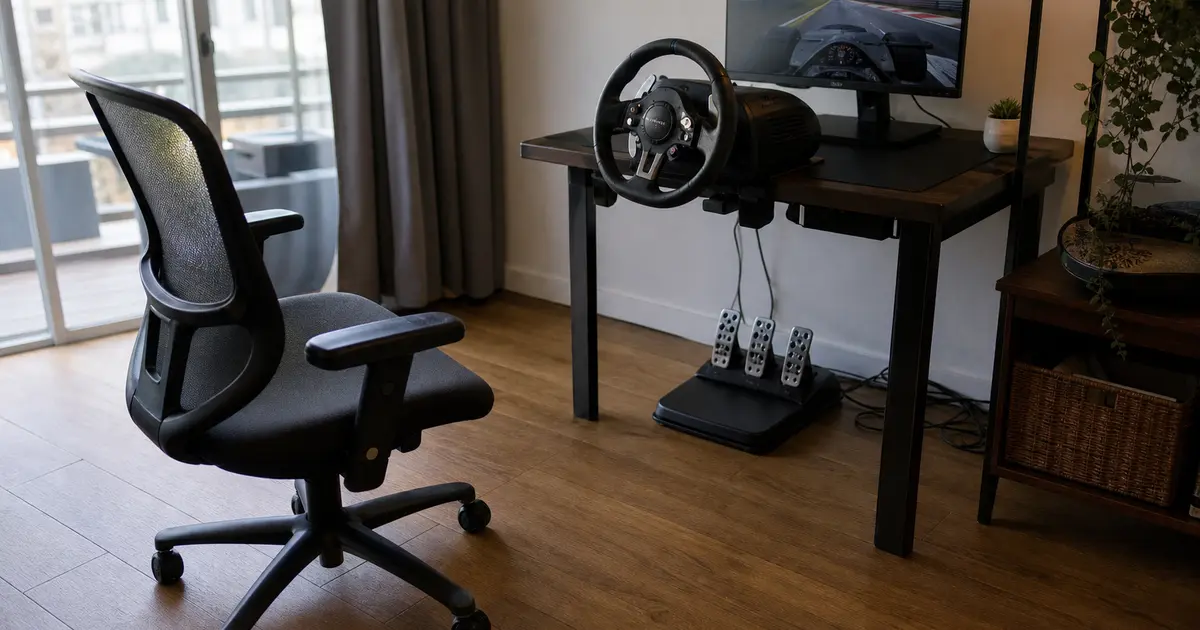

Choosing a sim racing seat is one of those decisions most people don't think about until they're halfway through a race and their chair has rolled three feet backward. If you've just unboxed your first wheel and pedals, set everything up at your desk, and discovered that every hard brake sends you sliding across the room — you're not alone. This sim racing seat guide covers every option available, from zero-cost fixes for your current office chair to full aluminum-profile cockpits that feel like the real thing.
Here's what we'll cover:
- Why your office chair keeps rolling away — and 7 proven ways to fix it
- Office chair vs. gaming chair vs. bucket seat — which actually works?
- Budget racing seats under $300 — real recommendations from the community
- Foldable and portable cockpits — for when space is tight
- Full cockpits and proper seating position — why rigidity matters
- Quick-reference comparison table to pick your ideal setup
The Rolling Chair Problem: Why Your Office Chair Won't Stay Put
Why It Happens
When you press a load cell brake pedal, you're generating anywhere from 30 to 90+ kg of force. That force doesn't just compress the pedal — it pushes your entire body backward. On hardwood floors, even a standard Logitech G920 brake spring is enough to send an office chair gliding. A carpet helps, but only slightly.
I keep pulling my wheel out while I'm driving. I do have a carpet underneath, but it's still moving. — u/FrankDanger (380 upvotes)
This is, by a wide margin, the most common beginner complaint on r/simracing. The good news: the community has tested every possible fix over the past decade. Here they are, ranked from cheapest to most robust.
Fix 1: Old Shoes (Free, Most Popular)

This sounds like a joke. It isn't. Putting the rear caster wheels inside a pair of old sneakers is the single most upvoted solution on every "how to stop my chair from moving" thread on Reddit.
"Place the wheels inside an old pair of shoes."
— u/FrankDanger (380 upvotes)
"This is the simplest answer that works. No reason to go further."
— u/rebel_scum65 (126 upvotes)
"I use my old pair of shoes under 2 of the wheels, the wheels sit fairly well inside and the rubber soles stop from sliding on wood."
— u/Hobo_Healy (13 upvotes)
The rubber sole grips the floor, and the shoe structure prevents the wheel from rolling out. Point the toes toward the pedals so the wheel sits deep in the heel area. This fix has been confirmed working on hardwood, tile, and low-pile carpet — and people are still thanking this advice eight years later.
7 year old comment saving my sim racing start up
— u/Nervous-Implement131
Fix 2: Silicone Stoppers and Caster Cups ($5–$15)
If you want something that doesn't smell like feet, silicone wheel stoppers are the next step up. They're small rubber cups that you place under individual caster wheels.
"These silicone stoppers worked well for me" — referring to WELLGO Bed Stoppers on Amazon.
— u/apk (23 upvotes)
"I have these exact ones. They work well enough. A little sliding around when mashing on a load cell but not very much."
— u/Ekimup (4 upvotes)
The catch: they hold up fine with standard pedals, but heavy load cell braking can overcome them. If you're running Fanatec CSL Pedals with the brake performance kit or anything stiffer, keep reading.
"I got a set of locking roller skate wheel castors, and they've been solid. I tried something similar to OP's suggestion, and they would fail under heavy braking."
— u/W4LNUT5 (3 upvotes)
Fix 3: Locking Caster Wheels ($15–$30)
Replacing your chair's stock casters with wheels that have built-in brakes is a cleaner permanent solution. You get normal rolling behavior when the brakes are off, and a locked-down chair when they're on.
"I bought wheels with brakes, works like charm :)"
— u/Maslakos (22 upvotes)
One user who systematically tested every method noted a downside: even locked casters have slight play in the mechanism, which can be annoying if you're sensitive to even small movements.
"The caster wheels had some play when locked in place, which really irritated me."
— u/No-Yesterday1591 (OP, tested all methods)
Fix 4: Remove the Wheels or Swap to Glides (Free–$20)
The simplest mechanical fix: just pull the casters out. Most office chair wheels pop out with a firm yank. You can either run the chair on its bare base (which may wobble if the gas cylinder has play) or install stationary bell glides in place of the wheels.
"Pull the casters off, they should pop out with a bit of force."
— u/Far_Store4085 (22 upvotes)
Bell glides are solid rubber feet that replace caster stems entirely. No rolling, no play. The trade-off is that your chair becomes stationary — fine for a dedicated sim racing spot, less ideal if you use the same chair at your work desk.
Fix 5: Ratchet Strap or Cargo Strap ($5–$10)
If you have a wheel stand or pedal mount, strapping the chair directly to it creates a rigid connection between your body and the pedals. The more you push, the more the system locks together.
"Get a ratcheting cargo strap with hooks, or a lashing strap. Removable, repeatable position and cheap."
— [deleted user] (5 upvotes)
One user discovered this after upgrading to a heavy brake pedal and finding that nothing else worked:
"Got myself the truebrake mod recently with the 40kg pedal, so I found out that the rug doesn't keep my wheel stand in place anymore. So I thought, maybe I can strap it in place. Works like a charm."
— u/mrjewellerman (OP)
Fix 6: DIY Cardboard or Yoga Mat (Free)
For a fix that costs nothing and takes zero effort: fold a moving box flat and park your chair on top of it. The wheels sink into the cardboard and can't roll. A thick yoga mat works on the same principle.
"I use an old Yoga mat under the chair, keeps it nice and planted. The thicker types of mats work best."
— u/_stormtrooper2k_
Another creative approach: cut tennis balls in half and place them over the wheels. The rubber grips and the ball shape prevents rotation.
"I took tennis balls, cut 'em in half and placed them under the wheels of my chair."
— u/alex__d (12 upvotes)
Fix 7: DIY Wooden Frame ($20–$30)
The most robust DIY solution: build a small rectangular frame from 2×4 lumber. The chair's front wheels drop into the frame, and the pedals are mounted at the other end. Any braking force is absorbed by the frame itself.
"This cost like $26 at Lowe's. Mount the pedals to the wood and put your front casters into the smaller rectangle."
— u/ReadAlarming9084 (2 upvotes)
Rolling Fix Comparison Table
| Method | Cost | Load Cell OK? | Setup Time | Floor Type | Verdict |
|---|---|---|---|---|---|
| Old shoes | Free | Partially | Instant | All | Best free fix, universally recommended |
| Cardboard | Free | No | Instant | All | Quick test, not a long-term solution |
| Yoga mat | Free–$10 | Partially | Instant | All | Works well on hard floors |
| Caster cups / stoppers | $5–$15 | Partially | Easy | Hard floors | Clean look, fails with heavy load cell |
| Ratchet strap | $5–$10 | Yes | Easy | All | Best value for load cell users |
| Locking casters | $15–$30 | Yes | Moderate | All | Permanent, slight play possible |
| Bell glides | $10–$20 | Yes | Moderate | Hard floors best | Rock-solid, chair becomes stationary |
| DIY wood frame | $20–$30 | Yes | 1–2 hours | All | Essentially a budget rig |
Can You Actually Sim Race in an Office Chair?
The short answer: yes, absolutely. Most sim racers start exactly this way. The longer answer: it depends on your pedals, your commitment level, and your pain tolerance.
What an Office Chair Can Do
For someone with a Logitech G29/G920 or Thrustmaster T248 using standard spring pedals, an office chair with wheel stoppers is a perfectly viable setup. You can race for months, improve your lap times, and figure out whether sim racing is something you want to invest more money in. There's no need to buy a cockpit on day one.
What an Office Chair Cannot Do
The limitations become obvious once you upgrade to load cell pedals. The force you apply to a load cell brake doesn't just slow the car — it pushes your entire body backward. Even with your wheels locked, an office chair still has problems:
- No lateral support. The seat pan is flat. Under heavy cornering in VR or during intense moments, you slide sideways.
- The backrest reclines. Most office chairs have a tilting backrest. When you push hard on the brake, that tilt absorbs some of your force instead of transferring it to the pedal.
- No repeatable position. Every time you sit down, the seat height, angle, and distance from the pedals is slightly different. Consistency — the foundation of muscle memory — is impossible.
Users on Reddit consistently report the same pattern of frustration:
"I got tired of battling with my desk chair and bought a proper racing chair a few years ago. Money very well spent."
— u/MaXKiLLz
"I got a lot of tension in my arms as I had to stabilize myself by clinging on to the wheel."
— u/d95err, comparing office chair to a proper racing seat
What About "Gaming" Chairs?
Gaming chairs — the kind with aggressive styling, LED lights, and bucket-seat-inspired side bolsters — are generally not worth the premium for sim racing. They look the part but share the same fundamental problems as office chairs: caster wheels, reclining mechanisms, and no fixed driving position. The extra side bolsters are too soft to provide real lateral support. You're paying for aesthetics, not function.
The skepticism on Reddit is consistent:
"Most 'racing style' gaming chairs are garbage for actual sim racing. They're designed for sitting at a desk, not for withstanding brake forces."
— Summary of comments on the racing chair doubt thread
For shorter riders, the problem is even worse — most gaming chairs can't adjust low enough for proper pedal reach. The office chair vs. gaming chair thread highlights this: users under 5'6" report that neither option provides a good driving position without extensive modification.
If you want to explore the dual-use angle (a seat that works for both daily computing and sim racing), the Reddit thread "Racing chair that doubles as office chair" is worth reading — the consensus is that no single product does both well, and a folding cockpit that you can tuck away is a better compromise.
I spent my first six months sim racing in a typical gaming chair like everyone has nowadays. When upgrading my pedals with springs, I found out that my chair and table are not close friends anymore so I was thinking about ways to fix it. Luckily, my room wasn’t big enough back then and I had my bed right beside my setup, so I just moved it closer and there was no space to roll back (I also had to tape the pedals to a big box stuffed with lots of books because they moved from the ground). When moving out, I bought special stoppers for my chair - replacement kit for wheels. It worked perfectly.
When to Upgrade
The upgrade signal is clear: if you've bought load cell pedals and find yourself fighting your chair more than the track, it's time.
Budget Racing Seats: Real Options Under $300
Your first real sim racing seat doesn't have to cost a fortune. Here are the options the community actually recommends.
Used Car Seats from Junkyards ($30–$100)
The single most common budget recommendation on Reddit. Go to a local junkyard, find a bucket seat from a sports car (BMW sport seats, Recaro-equipped vehicles, older Honda Civic Si seats), and mount it to a DIY frame. The lateral support is genuine — these seats were designed for real-world cornering forces.
The downside: you need to build or buy some kind of frame to mount it. A used seat alone won't solve anything without a structure that also holds your pedals and wheel.
Budget Bucket Seats from AliExpress and Amazon ($80–$200)
Dedicated racing-style bucket seats are available from $80 on AliExpress and $120+ on Amazon. Brands like Circuit Performance, JEGS, and various generic options show up frequently. Look for:
- Side-mount or bottom-mount compatibility (side-mount is more standard for sim rigs)
- Dimensions that fit your body — many budget bucket seats are narrow
- Cover material — cloth breathes better than PVC for long sessions
The Reddit thread on best budget racing seats is full of specific model recommendations with real pricing. Users also note that street car seats from a junkyard are often more comfortable than pure racing buckets, since they're padded for daily driving, not just competition.
Playseat Challenge ($200–$280): The Gateway Cockpit
The Playseat Challenge is probably the most recommended "first real seat" in the sim racing community. It's a folding cockpit that includes the seat, wheel mount, and pedal plate in one package. Setup takes 10 minutes, and it folds flat enough to slide under a bed or stand in a closet.
"I finally went ahead and got a Playseat Challenge and it made all the difference in the world! My driving improved drastically!"
— u/Ok_Letter4515
Limitations to be aware of: the frame flexes under heavy load cell braking, the seat isn't adjustable for angle, and taller users (6'1"+) report leg cramping. There's a wider "Logitech" variant that addresses the leg room issue.
Budget Cockpit Builds from the Community
The Reddit thread on budget-friendly cockpits reveals that some users are building full rigs for under $200 using parts from Temu, generic 80/20 profile from AliExpress, and junkyard seats. The cheap-end cockpit discussion is another useful reference for specific price-to-performance recommendations.
Foldable and Portable Cockpits: When Space Is Limited

Not everyone has a spare room for a permanent sim racing rig. If your setup lives in the living room and needs to disappear after each session, foldable cockpits are the answer.
Next Level Racing GT Lite ($200–$250)
A lightweight folding frame with an integrated seat. Popular as a starter option, but the Reddit verdict on honest opinions about the Next Level Racing foldable is clear: great for starting out and saving space, but the flex under heavy braking is noticeable, and it's not ideal for direct-drive wheel bases above 5–8 Nm.
Playseat Challenge (Again — Because It Dominates This Category)
For pure foldability, nothing beats the Playseat Challenge. It's the default recommendation for apartment dwellers, and for good reason:
- Folds in under 60 seconds
- Stores vertically (takes up about as much space as an ironing board)
- Compatible with most consumer-grade wheels and pedals
- The seat itself provides decent lateral support
Semi-Frame Designs: A Middle Ground
An interesting alternative that's gaining traction: semi-frame rigs that aren't fully foldable but are compact enough to tuck against a wall. The Reddit thread on a semi-frame sim rig showcases a design that's stiffer than a folding cockpit but takes up less space than a full 80/20 rig. There are also custom foldable DIY rigs that combine rigidity with portability.
For Tall Users
Height is a real constraint with foldable rigs. The stand vs. cockpit discussion for tall users reveals that users above 6'1" often can't get comfortable in the Playseat Challenge without modifications. For taller sim racers, a wheel stand paired with a separate office chair and good wheel stoppers might actually work better than a compact cockpit that doesn't fit.
Full Cockpits and Why Rigidity Actually Matters
If you've made it this far, you're probably wondering: is a full sim racing seat and cockpit really worth $500+? The answer depends entirely on your pedals.
The Practical Difference
This question was asked directly on Reddit, and the answers are revealing:
Racing seats offer rigidity for precise load cell pedal inputs. Office chairs have "slop and play" even when immobilized.
— Summary of top comments on the practical difference thread
The core insight: a rigid cockpit creates a closed force loop. When you push the brake pedal, the pedal pushes back against the frame, the frame pushes against the seat, and the seat pushes against your body. The force has nowhere to go except through the pedal sensor. In an office chair, that force is absorbed by the chair's tilt mechanism, the wheel base clamp, and the flex in your desk. You lose precision and consistency.
What a Full Cockpit Gives You
- Exact pedal inputs. With a load cell brake, you can modulate braking force to within a kilogram. That precision vanishes if your seat or pedal mount flexes.
- Repeatable position. Your seat, wheel, and pedals are bolted in place. Every session starts from the exact same configuration. Your muscle memory builds session over session.
- Direct-drive compatibility. Wheel bases above 8 Nm of torque will flex a wheel stand or desk mount. A full rig absorbs that force without complaint.
- Bass shaker mounting. Hard-mounting a transducer directly to the seat frame delivers tactile feedback you simply can't get through a freestanding setup.
Popular Full Cockpit Options
- Sim-Lab P1-X ($500–$700, frame only) — the community standard. Extremely rigid, infinitely adjustable, compatible with nearly every seat and pedal on the market.
- TRX Sim Racing Cockpit — a close competitor to Sim-Lab with similar 80/20 profile construction.
- GT Omega ART — good value option, often bundled with a seat.
- DIY 80/20 profile build — buying extruded aluminum profile directly from a supplier (like Misumi or a local metal shop) and building your own frame. The cheapest path to a full rig, but requires more planning.
When to Make the Jump
You don't need a full cockpit with a Logitech G29. You do need one if:
- Your wheel base is direct-drive at 8+ Nm
- You're running load cell pedals (Heusinkveld Sprint, Simucube ActivePedal, Fanatec CSL with upgrade kit)
- You race endurance events (2+ hours) and need consistent physical comfort
- You've spent more than 6 months in the hobby and know you're in it for the long haul
Proper Seating Position: How to Sit for Sim Racing

The best sim racing seat in the world won't help if you're sitting in it wrong. Position matters more than price — here's why and how to get it right.
Why Position Matters
In real motorsport, seating position is a safety-critical setup parameter. In sim racing, it's a performance and comfort parameter. A correct, repeatable position builds muscle memory — your body learns exactly where the brake pedal is, how far to push, and when to turn the wheel. If your seat is slightly different every time you sit down (hello, office chair), that learning process takes longer.
The GT Driving Position
Most sim racing disciplines use a variation of the GT position:
- Seat backrest angle: 30–35 degrees from vertical
- Arms: slightly bent at the elbows when gripping the wheel at 9-and-3 — never fully extended
- Legs: slightly bent at the knee when the brake pedal is fully depressed — you should never be pushing with a fully straight leg
- Hip-to-knee angle: roughly 100–110 degrees
- Distance from wheel: close enough that your wrists rest on top of the wheel rim when you extend your arms straight
This is the position recommended by Ricmotech's seating guide, which is frequently cited on Reddit whenever someone asks about correct posture.
Common Mistakes
- Sitting too far from the pedals. If your legs are straight when braking, you're generating force with your quads instead of your body weight. This is tiring and imprecise. Move closer.
- Arms fully extended. If you can grip the wheel with locked elbows, you're too far away. In a crash simulation (or just a heavy FFB event), straight arms transmit all the force to your shoulders.
- Wheel too high or too low. The wheel center should be roughly at chest height, angled slightly toward your face.
The Reddit thread on proper seating position has detailed step-by-step instructions, and the seating position recommendation thread includes additional community tips.
In-Game Seating Position
Don't forget that most sim titles (iRacing, Assetto Corsa Competizione, rFactor 2) have their own in-game seat and camera adjustment. The in-game seating position guide on Reddit walks through the process for popular titles. The rule of thumb: your virtual hands and your real hands should be in the same place.
Quick-Reference: Which Seat Solution Is Right for You?
| Type | Examples | Pros | Cons | Best For | Price |
|---|---|---|---|---|---|
| Office chair + stoppers | Any office chair with DIY fixes | Free to start, multifunctional | No lateral support, flex, not repeatable | Absolute beginners, casual racers | $0–$30 |
| Budget bucket seat | Junkyard car seat, AliExpress bucket | Real lateral support, stiff, authentic feel | Needs a frame, less adjustable | Enthusiasts willing to build | $80–$300 |
| Foldable cockpit | Playseat Challenge, NLR GT Lite | Compact, quick setup/teardown, all-inclusive | Frame flex, limited adjustment | Apartment dwellers, space-constrained | $200–$400 |
| Full cockpit (80/20 profile) | Sim-Lab P1-X, TRX, GT Omega, DIY | Maximum rigidity, perfect position, fully customizable | Expensive, permanent, needs assembly | Serious sim racers, long-term setups | $500–$2,000+ |
Decision Framework
- Budget under $50? Fix your office chair with shoes, cardboard, or a ratchet strap. Race. Improve. Decide later if you want to spend more.
- Budget $200–$300? Playseat Challenge. It's the community's default first upgrade for good reason.
- Budget $400–$700? A budget bucket seat on a GT Omega or Sim-Lab entry-level frame. You'll get 90% of the rigidity of a premium rig at half the price.
- Budget $700+ and you know sim racing is your thing? Full 80/20 profile cockpit with the seat of your choice. You won't need to upgrade again.
Conclusion: Start Where You Are, Upgrade When You're Ready
You don't need to drop $2,000 on a cockpit on day one. The progression is real and well-documented by thousands of r/simracing users:
Shoes under the wheels (free) → locking casters or a ratchet strap ($10–$30) → Playseat Challenge ($250) → full 80/20 profile rig ($500+)
Every level works. Every level has been tested and confirmed by real people with real budgets. The key principle: your seating position and its repeatability matter more than how much you spent on the seat itself. A $30 junkyard bucket in a DIY wood frame, positioned correctly, will outperform a $500 cockpit with a lazy driving posture.
The right sim racing seat is simply the one that lets you focus on the track — not on your furniture.